Thursday, July 23, 2009

Diversions

I've got quilts on the brain. Let me preface this by saying that I am in no way a sewer! The extent of my past sewing experience pretty much involves making my own hair scrunchies back in the seventh grade (hey, it was the nineties, they were still cool!). I'm always impressed and awed when I see beautiful handmade quilts posted on other people's blogs (check out these adorable potholders!), and wish that I had the same talent.

So, since there is an overabundance of rainy days and I've got the free time right now, I decided to work on a few projects.

Back in high school I made a t-shirt quilt as a semester project. Essentially, it was a solution to the problem of having many many oversize t-shirts hanging around, that I never wore but couldn't get rid of because they came from an event or had sentimental value of some sort. I wanted the quilt to take with me when I started university, and it sat happily on my dorm room bed for four years.

A few years ago I decided to make a second one, and got as far as piecing the front panel together. Admittedly, I did a sloppy job of the whole thing, mostly because I bought the wrong type of interfacing, and didn't have a rotary cutter or good way of cutting the pieces evenly. It's been sitting in my closet for three years now, waiting to be finished... mostly because I wanted to track down the rotary cutter and mat that I had borrowed in order to cut the strips for the binding. I gave in and went to Fabricville today, and bought a cheap mat/cutter set (hopefully it works and I won't regret skimping!), so I no longer have an excuse not to finish this!


The store was also having a very good sale on some of their fabrics, so I picked up some material to make a few knitting needle holders. I made one for myself and one for my mom several years ago, and was quite pleased with the way they turned out. The lady at the store commented that I must like muted tones, and that the fabrics reminded her of Little House on the Prairie. It's true, no matter how hard I try to like the bold, fun fabrics, I'm always drawn to the more earthy and natural tones (case in point - the last four things I've knit have been green).


Prairie-esque?

We shall see how this goes, this time around I vow to read up on proper techniques instead of just trying to do things right off the bat!

Tuesday, July 21, 2009

Picking up the Slack

It finally feels like summer! Today was hot and sunny, and since I'm done work I had the luxury of sitting out on the deck to knit for the afternoon. For the last two weeks, work had pretty much drained me of any motivation to do anything at the end of the day other than sleep and study, so knitting took a bit of a back seat. However, having just spent the weekend at a wedding and family reunion in Maine, I had the time to finish up one of Nanny's socks.


This yarn (Lorna's Laces Shepherd Sock) has been sitting in my stash since early 2006. I had meant to use it to make the Dublin Bay socks, but the pooling had been so bad that I frogged them not far into the project. I was weary of pooling this time around, but it hasn't been too bad other than around the gusset. The yarn does have a smooth drapey feel to it, however!

There are so many lace shawls that I would love to be knitting right now... so many that I couldn't make up my mind as to what to start. I had been planning on knitting the Waves of Grain scarf as a gift for someone, so I decided to get that out of the way. I had some Plymouth Baby Alpaca Lace on hand, in a color that reminded me of the intended recipient.

I think I need to invest in one of those magnetic chart holders! While the lace pattern itself isn't difficult, the whole process of threading tiny seed beeds onto the stitch with 32-gague wire slows the knitting down considerably. I don't mind for the moment, as I'm enchanted with the whole process and love the subtle way it looks!
I have a sneaking suspicion that this will become a tedious project when I reach the middle section, so while I'd like to have it done by the fall I'm not going to pressure myself to work on it!


I've finished up another project, which you can see over here (Ravelers only, it's a gift!). I'm quite happy with the way it turned out, so it's off to the closet until Christmas time!


Saturday, July 04, 2009

Green Sleeves

It's Saturday, and despite the fact that it's now July the sun has yet to come out, and it's cold enough to curl up with tea, wool socks, and a sweater. While I'm frustrated with the endless rain, it is a good excuse to hunker down to read and knit. I feel particularly bad for the farmers around here who are having a hard time with their crops because of it. Sun - please show your face!!!

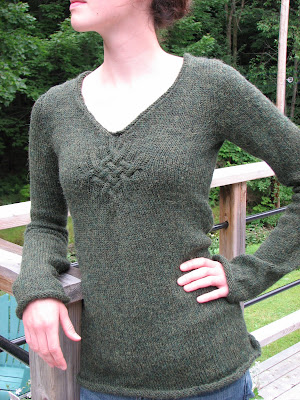
Enough about the weather...it stopped raining long enough for me to finally snap a few outdoor photos of my finished Gathered Pullover. For the last few weeks I had been feeling a serious lack of knitting motivation; the endless stockinette of the pullover's sleeves was boring me to tears, and I couldn't figure out what project to start next. Now it's done, and I love it!


Gathered Pullover by Hana Jason, Interweave Knits Winter 2007


A while back Whitney posted about the sweaters she's knit (I love her taste in sweaters), and which ones she wound up wearing. What she said rang true with me- the sweaters I'm apt to wear will probably be the simplest ones, which I also don't like to knit as much. Finally I've managed to knit a sweater that I think I'll wear often, which I can't say for the other four knit tops that sit in my closet and never see the light of day.

Mmm, cozy long sleeves

I love the simplicity of this pattern, and the ease with which it can be modified. Being a longish gal, I added quite a bit of length in the body and arms. A sweater that's too short is irksome, and I enjoy having sleeves long enough to tuck my hands into when it's cold and I'm hibernating in the library basement. I also left out the bust increases and decreases, and widened the shoulders a bit so that the V-neck wouldn't be quite as wide and deep. The yarn is Berroco Ultra Alpaca Light, in the color Peat Mix. I love the deep, heathered green, and soft feel of the yarn. It's lightweight enough to be worn comfortably indoors.


No rain, for the moment!

This was definitely a project that I knit more for the finished product than for the actual enjoyment of making it, but I like the sweater enough that I would do it again!

Tuesday, June 30, 2009

Lies and Ties

When you were a kid, did you ever accidentally break or lose something of your parents, grandparents, or friends, only to not mention it in the hope that they wouldn't notice it was missing? Tonight the truth came out, and I had a good laugh over it (maybe because today was the 16th straight day of rain we've had, and I'm starting to feel stir crazy). My grandparents were visiting, and Nanny was gushing over how she adores the little ankle socks I knit her a while back. I hauled out my sock yarn stash (it is a bit of a beast) so that Nanny could pick out some yarn for a future pair of socks. Grampy was examining the yarn, and inquiring about washing directions. Mom was explaining how some yarns can go in the washer/dryer while others can't.... and then looked guiltily at me.

Nanny's choice

Last year I had knit myself a pair of plain socks out of some light blue Koigu. I loved them... and then, they dropped off the radar. As it turns out, mom had done some laundry while visiting me last fall, and had accidentally shrunk my socks. Shrank them so much, in fact, that they wouldn't have fit a little kid (and I have BIG feet). She felt so badly that she just didn't mention it, until it leaked out tonight! I had a good laugh... moral of the story being that Koigu does not do well in the dryer!

And now for a final bit from the farm...
Chris is really into natural dyes. She has a dye "kitchen" in the back yard, where she holds workshops and dyes her yarns. One afternoon, she was running a Shibori workshop for a local weaving and knitting guild. Shibori is basically an ancient Japanese form of tie-dying, in which fabrics are stitched, tied, and folded to create a resist, and then dyed with indigo. Indigo is the only naturally occurring blue dye, and has an interesting mechanism of action. Indigo "vats" have to be reduced using something like uric acid. When an item is dipped in the vat and then removed, the dye becomes oxidized, and the molecules form a mechanical bond with the fabric. The fabric comes out looking lime green, and then transforms into a deep blue over then next minute or so. I tried to take a video of this happening while remaining unobtrusive...


Untying the goodies

Finished silk scarves and fat quarters

There is also a lot of interesting folklore surrounding dye vats. In some areas, fertile women were thought to be able to 'spoil' the vat, so only women past childbearing age were allowed to tend to it. Anyhow, the workshop was fun, and I got a neat wall hanging out of it. Honestly, however, I don't really have the patience or interest to get into the dyeing end of things... but it was educational nonetheless. We dyed some merino roving with the leftover vat, and I was able to spin 100g.

Wetting the roving before dyeing

Fresh out of the vat

Conditioned roving, waiting to be spun!

Finished indigo skein

I have a FO and a new project to show... maybe tomorrow!

Thursday, June 25, 2009

You Spin Me Right Round

So finally I've mustered up the energy to document my spinning journey on the farm! Chris wasted no time getting me started with spinning. She was a spinner first and a knitter second, and enjoys spinning immensely. She sells some of her handspun, from her own animals' wool, in the Joybilee store. The rest of their fleece gets sent off to be mill spun, after which Chris dyes it on the farm.

The Dalziel's son is a professional sheep shearer, and had sheared all of their animals last fall. The fleeces needed to be sorted and cleaned to be put in the shop, so I got to learn how to tackle a raw fleece.


First, the fleece is unrolled and placed on a wool sorting table (basically a wooden frame covered with chicken wire). The goal is to identify the neck wool and bum region. The neck wool has a really fine crimp and a different feel to it (it was traditionally used in Shetland knitting), whereas the bum region has lots of "dags", which are basically clumps of poo. The fleece is then "skirted", which involves separating off the edges with dags. The midline, which corresponds to the back of the animal, is usually covered in chaff (bits of hay and dirt that have been dropped on the animals); this is removed as well. The remaining fleeces is bounced on the wire table so that short "second cuts", where the shearer has passed over the wool twice, fall through and are separated out. Any large bits of vegetable matter are also removed. We wore gloves to do this, as the wool has a lot of lanolin and dirt at this point. It feels greasy and wet, and has quite the odor as well! Once the fleece has been skirted, it's ready to be weighed and washed.


Chris and Sarah skirting the fleece

Leftovers make good puppy toys!

Chris very generously gave me my own fleece (!!!), from a Romney cross sheep named Platinum. I washed the fleece at the farm, which was quite the process. I didn't realize how much work went into this! I used a double sink filled with extremely hot water (it should be too hot to touch). One sink serves as the washing sink, the other as the rinsing sink. A handful of the fleece is plunged into the washing sink along with a good dose of dish soap. It is left to soak for about 10 min, so that the dirt and lanolin can come loose. You can swish it around a bit, but I started to run into problems with felting the fleece from handling it too much. It was hard to strike a balance between getting the tips clean, but not felting it! The fleece is then transferred to the rinsing sink, which should be of equal temperature. The wash-rinse cycle is repeated 3-4 additional times for each handful of fleece. It took 5 long, patient hours to get the whole thing washed, and mine was a small fleece. After it has been washed sufficiently, the handfuls of fleece are left to drain in a colander. It was then spun dry in the washing machine, and left to dry further in wicker baskets.

My fleece before washing


I'm sure there are many ways to wash fleeces (Chris sometimes also does each lock by hand, which takes much longer); this was just the way I was shown. Before spinning it, I'll have to hand-comb each lock with my dog's old flicker brush - an acceptable substitute if you don't want to buy a hand carder. Spinning my fleece will be a long-term project, one that I probably won't get going on for a while.

After washing!

Chris started me off spinning with some white wool roving on an Ashford drop spindle. First off, take a look at the living room- what fiber artist/knitter/spinner/weaver wouldn't drool over this? I made myself a little nook on one side of the room, with a basket Chris gave me to hold my fiber. She taught me the park and draft method of spinning on the drop spindle, which I found to be quite hard on my back and shoulder. If I do keep spinning on a spindle, I'll likely look for another method to try.


Soon after, she had me going on the Ashford Kiwi. It felt quite awkward at first, but as soon as I felt more comfortable with the mechanics of it, things went really quickly. I was amazed at how fast yarn can be made - much more instantly gratifying than knitting, and so meditative as well! In a few days I had spun two bobbins of worsted singles. Sarah then showed me how to ply on the Lendrum wheel (which I found much more difficult to use). We wound it on a niddy-noddy, and then washed the skein in lukewarm soapy water.


A few days later, we dyed some roving with indigo (more on indigo dyeing later), which I then spun. My main problems were with having too much twist in the yarn, and then when I tried to correct it, winding up with singles that just fell apart. My final plied yarn wound up fairly well balanced (this is measured by holding up the skein and seeing if it twists one way or the other). The blue skein is finer than the white, but I'm thinking that I may still knit them up together.


Too twisty...but less lumpy

Overall, I loved spinning and would really love to have a wheel. It will be hard to go back to a drop spindle after the ease and speed of the wheel, but that's where I'll be for a while yet. I'm very grateful to Chris for her generosity, and love the idea of bringing a fleece from the raw product to a finished knit item! This could be another fiber addiction coming down the road... danger!

Saturday, June 20, 2009

Wooly Goodness

I've always been curious about what it would be like to live on a farm. Immersion in life with the Dalziels at Joybilee farms definitely satisfied that curiosity - one of the things that struck me right away was how different the rhythm of the day was. We're used to regimented schedules, having to show up for work etc. at certain times, having a rough idea of what our days and weeks will hold. On the farm, no one wore watches. The day's activities were dictated by nature, the animal's needs, things that would occur unexpectedly such as a customer or sick animal.

The flock going out to pasture


I slept in a small trailer behind the house, and would wake up at 5 or 6 am to sunlight and the sounds of roosters and chickens (usually the cold would keep me from getting up for a while yet!). I felt a bit like Chris in the Morning from Northern Exposure, and it was kind of fun! Robin would usually be up early doing chores. We'd convene for breakfast at 7:30, and then start our chores at 8. Chores were things that were done every day, usually at 8 am and pm. These were the things that had to be done, such as feeding the animals and letting them out to pasture. My main chore was taking care of 30 Angora rabbits. After chores, we would do whatever work needed to be done around the farm: if it wasn't raining, usually this involved weeding and mulching the gardens, clearing the orchard, or shovelling manure out of the barn. I loved the meditative, physical nature of the work, especially being down in the gardens.

Topaz, an Angora rabbit we brought in to be groomed

Other times, the work would involve fiber-related stuff, like plucking the angora rabbits, skirting and sorting fleeces, or getting ready for workshops. In the afternoon, when it would be too hot to work outdoors, we would do lighter indoor work, or go into town for errands. After dinner, sometimes we would do some more work, or do something like go for a walk on the acreage. By the time everyone finished up evening chores it would be 9pm or later, and we'd meet up in the living room for an hour of rest before bed (often this involved watching documentaries while spinning). Some days were lighter than others, and often we'd all be exhausted at the end of the day.
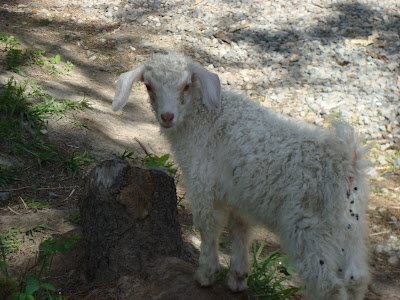

A kid Angora who got separated from his mom


I learned pretty quickly that you can't be type A or a perfectionist with farm work, or you would never rest (you can't pull every weed out of the garden or pick up all of those little twigs!) . Things can also change at the drop of a hat, so you have to be pretty flexible as well. It was neat to see how the Dalziels had figured out what worked and what didn't, and that they are still learning daily.

Amaretto and her brand-new cria Latte

One of my favorite things at the farm was spending time with Chris. She was so knowledgeable, and perpetually cheerful despite whatever calamity may have been happening. She understood what my goals in being there were (to learn how to spin, and to see if having a hobby farm would be something I'm interested in in the future), and catered to that. She was a total task master when it came to getting my spinning done, and I loved it!

Donder and Gelato

By the end of my time there, I had a solid sense of how wool processing works from the ground up. The Dalziels have a flock of over 100 sheep and goats. Their sheep are mostly Romney and Rambouillet. They have several Angora goats (which produce mohair), as well as Sanaan dairy goats. They also had seven guard llamas, 8 dogs, over 50 chickens, ducks, two turkeys, the Angora rabbits, and a few cats. That's a big brood for one family to take care of, on top of trying to garden and run a business!

Llamas sauntering by: Cappuccino, Latte, Amaretto, Mocha, Saline, and Espresso

I absolutely loved the animals, but had a special fond spot for the dogs, especially my good buddy Gelato. Gelato is a 1 year old Maremma (livestock guardian dog), who at his less-than-full size still outweighs me. These dogs will sacrifice their life to fend off cougars, bears, and coyotes, but have only gallons of goofy love for humans! He and Donder, a Great Pyrenees, had five puppies. I would find myself hanging out with Gelato, only to be surrounded by six other affectionate dogs seconds later. It was awesome.

A happy moment of dog love with Donder, Gelato, and brood!

The goats and sheep were more aloof, and aside from the three "bottle babies" who were used to being fed by humans didn't really care to interact with me all that much. The llamas on the other hand, were very curious and expressive, and would saunter right up to say hi. One of the llamas, Amaretto, had a baby cria while I was there. It was so cool to see her interact with it in such a loving way right after it was born!


The flock coming up from pasture


I have to wrap this up, as I'm leaving for home tomorrow and still have a lot to do. I will get to the fiber stuff soon, I promise!!

Thursday, June 18, 2009

Mission Accomplished

I'm back - having indeed had a great dose of the outdoors, animals, fibery stuff, and learning. The farm experience was difficult, interesting, educational, and wonderful all at once. I have to say a huge thanks to all of my friends who pitched in somehow to make this trip as great as it was; they fed me, housed me, drove me to airports, train stations and bus stops, gave advice, and lent encouragement and support. I feel so lucky to have all of you in my life!

I'll separate the fiber stuff into a separate post so that you can read only what interests you! The trip started off with a train ride to Toronto, and an overnight stay with a friend. The next day I took off to Kelowna, BC to stay with another friend. I was flat out in love with the city from the moment I got there - it was hot, desert like, and looked like a Californian suburb (as seen on TV) surrounded by mountains. We hiked around Myra Canyon/Kettle Valley and Knox mountain, taking in the wonderful sunny day.


Views from Kettle Valley/Myra Canyon, Kelowna BC

The next afternoon I headed off on a bus to Greenwood, BC, which is in the Kootenay boundary region. The bus ride itself was impressive, winding through mountains on roads that looked down on valley ranches. Greenwood is Canada's smallest city (pop. ~700), which used to be a bustling center during the gold rush era. There, I met up with Robin and his daughter Sarah, who took me to the farm. It was definitely challenging to get used to being so isolated on the farm, being plunged into a new family, with no time to myself. However after a few days of adjusting and getting to know the Dalziels, I started to really enjoy all the farm had to offer. More about that later!

After the farm, I took the bus back to Kelowna and flew to Vancouver, where I met up with a friend to do some camping and hiking. We stayed in Alice Lake Provincial Park (which was impeccably well kept), and hiked the Stawamus Chief trail as well as Garibaldi Lake. Both hikes were well worth the strenuous effort, boasting awesome scenery at the summit. The "Chief", which is supposedly the second largest granite monolith in the world, was a shorter but more strenuous hike, involving scrambling over steep boulders, chains, ladders, and steep stairs. The trail up to the first peak was fairly populated with tourists, but that thinned out considerably as we hiked to the second and third peaks. We found a lesser used route down from the summit, which took us through a pretty neat fir forest.


View of the Puget Sound area from the 1st peak of Stawamus Chief

On the second day, we hiked up to Garibaldi lake. This hike was considerably longer, but other than the first few hours of leg-burning switchbacks, not as difficult as the Chief. We passed only a few other hikers, which made for a peaceful experience! The trail was still snow covered near the summit, and the scenery at the top was breathtaking- a glacier-fed, turquoise lake surrounded by snow-capped peaks. We had planned to do another big hike on the third day, but our bodies were protesting from the previous days' efforts, so we took in some sights around Vancouver instead, hiking around Lynn Canyon, Stanley Park, and UBC. We also drove out to see Whistler, the site of the 2010 Olympic nordic events. The next morning it was off to Montreal, and then home to Kingston via train.


Lookout point on the way up to Garibaldi Lake

Garibaldi Lake, BC


I'm head over heels in love with BC- for some reason Vancouver, despite being a big city, doesn't elicit in me the same gross gut reaction that other big cities do. I also love how people there seem to universally embrace an active, outdoor lifestyle. The Squamish area was stunning, and I would love to go back and do more hiking there in the future! I'm glad to be back home, if only for a few days before leaving for New Brunswick (just for fun I made a map of the whole trip).

Saturday, May 30, 2009

Off to Fiberland

It's late, and I should have been in bed long ago. Today was long and productive - I got my papers for the research ethics board submitted just under the wire, confirmed my job placement for later in the summer, crossed 16 things off my to do list, and packed. Ahhh, it feels good to be done.

Tomorrow I head off on an adventure of sorts: after many failed summer plans I decided on a whim to take off to BC for a few weeks. I'll be at Joybilee Farms exchanging my labor for a place to stay, and hopefully some lessons in spinning, weaving, homesteading, animal rearing, and whatever else I can get my hands on. Joybilee is a fiber arts farm, run by a husband and wife team who rear their own fiber-bearing animals, spin the fleece, and dye their yarn using natural methods. They also do some other nifty things like making their own cheese and goat's milk soap. I've been wanting to learn how to spin for quite some time now, so hopefully this will be a good chance to get a firsthand look at how it's done. I also have a pipe dream of moving somewhere out in the country and having my own hobby farm with fiber animals and dogs and vegetables... for now I'll just escape to my dream life temporarily:)

Not much knitting has been going on here lately. The gathered pullover now has a sleeve, but I'll admit to being a bit bored by all the endless stockinette. For the trip, I'm taking along a mystery project (it's a gift, so I'll add a Ravelry link later).


I'll be back in three weeks, hopefully with lots of pictures and stories. Here's hoping to get a healthy dose of dirt, animals, fresh air and sun before returning to the sterility and order of the hospital!

Sunday, May 24, 2009

The Breakup Shawl

It's done, it's finally done! I present to you the Pacific Northwest shawl, aka "the Breakup shawl". I can tell the story now, as almost a year later there's some humor to be found in it.

Pacific Northwest Shawl By Evelyn A. Clark. Yarn: Valley Yarns 2/14 Alpaca Silk

This shawl has sentimental value to me for several reasons. I first saw the pattern knit up by one of my college peers as a sample at WEBS. It was one of the most stunning things I had ever seen (having not had much exposure to lace), and on my last visit to Northampton a few years ago, I picked up the yarn and the pattern to make the shawl. This was to be a long-term project, and was my first go at anything beyond a simple lace pattern. However, in the year that followed I couldn't find a good reason to cast on, as I didn't know the right person to fit the shawl.


And then I met her: a bold, striking, intelligent woman who lived on the west coast, who looked like the shawl-wearing type. She also happened to be the mother of my now ex. I loved this woman dearly - we had many frank and wonderful conversations, and she treated me like part of the family. Having finally found the right reason to cast on for the shawl, I began knitting, thinking of giving it to her on a happy occasion somewhere down the road in our relationship.


Did I in some way insult the knitting gods so as to prompt them to smite me? Had I found myself some perverse permutation of the legendary boyfriend sweater curse? No later than four days after I had cast on for the shawl did I receive an email ending my relationship. Darn it. After that email, I just couldn't stop knitting. Counting YO's and k2tog's was so much easier than thinking. The shawl provided a source of comfort and focus during the months that followed when being alone with the thoughts in my head was too hard.


I shall certainly be more wary of knitting for future relationships, having also knit three lovely pairs of man-socks into the cavernous hole of no return. However, when knitting is for some of us one of the strongest ways to say "I care about you", that's easier said than done.

The shawl is still going to the originally intended recipient (it's not her fault things turned out the way they did!). Part of me doesn't want to send it off knowing that I'll never see it again, as it reminds me of those marvelous Northampton days, and because it's been a fixture in my knitting basket for so long. At the same time, it also reminds me of less-good times, and clearing out the closet might just be best.

Now that the shawl is done and blocked (what a cool transformation), I'm itching to start a new lace project. What should it be?

Saturday, May 23, 2009

View From Saturday

Gould Lake Conservation Area, Sydenham ON


Nothing like a little summer fun with a borrowed dog on a Saturday afternoon.